
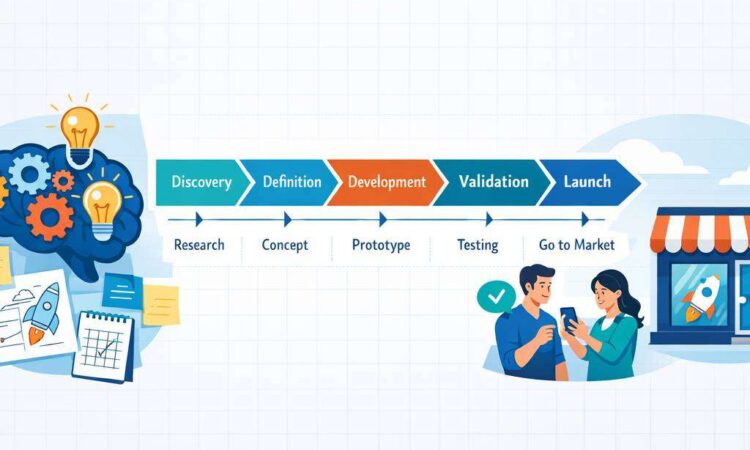
Launching a successful new product is less about a brilliant single idea and more about a repeatable, practical framework. In my years as a product development consultant, I’ve seen great concepts stumble at the first hurdle because the path from idea to market was unclear. This guide lays out a pragmatic framework you can apply whether you’re exploring product development services, seeking a partner for development of new products, or building an in-house process with a product development consultant. We’ll cover the end-to-end journey, highlight common pitfalls, and offer actionable steps to keep momentum from concept to launch.
Clarify the Opportunity: Define Problem, Audience, and Value
The first stage is not about features; it’s about understanding the problem you’re solving and who experiences it. Start with a clear problem statement:
- Who has the problem, and how is it currently solved?
- What pain points are most acute, and how frequently do they occur?
- What would a successful outcome look like for the user?
Complement the problem frame with a target user persona and a value proposition that answers: Why us, why now, and why is this product better than alternatives? This phase often involves rapid market insights, stakeholder alignment, and a high-level feasibility read. If you’re engaging in product development outsourcing or new product development consulting, insist on a concise discovery sprint that yields a validated problem-solution fit before investing in development of new products.
Validate the Concept: Feasibility, Viability, and Desirability
A robust idea must pass three lenses: technical feasibility, economic viability, and user desirability. Use a triad of quick experiments:
- Desirability: Prototyping or storyboard exercises with potential users to confirm interest and usage patterns.
- Feasibility: Technical assessment to identify core components, required competencies, and potential bottlenecks.
- Viability: A lightweight business model analysis, price sensitivity, and forecasted unit economics.
This is where product development outsourcing can shine. External partners can run independent feasibility checks and run small pilots, allowing you to move beyond internal biases. A quality NPd new product development process includes these validation loops early, keeping development focused on options with real upside.
Design and Plan: Architecture, Roadmaps, and Risk Mitigation
Once the concept shows promise, translate it into a concrete product architecture and a staged development roadmap. Key activities include:
- Defining minimum viable product (MVP) scope: Identify the smallest set of features that delivers core value and can be tested in the market.
- Architectural decomposition: Break the product into modules or components with clear interfaces to reduce risk and enable parallel workstreams.
- Risk assessment: Catalogue technical, regulatory, supply chain, and market risks. Develop mitigation plans and decision gates.
A practical framework uses two types of roadmaps:
- A learning roadmap for the MVP phase, detailing experiments, success metrics, and decision points.
- A delivery roadmap for post-MVP growth, including feature rollouts, manufacturing considerations, and go-to-market timing.
If you are collaborating with a product development consultant or a product development company, ensure the plan emphasises iterative learning and staged funding. Clear exit criteria at each stage prevent scope creep and preserve agility.
New product development drives growth by turning ideas into market-ready offerings that meet user needs and outperform competitors. A structured approach—from ideation to validation—reduces risk and accelerates time-to-market. Teams should prioritize customer insights, rapid prototyping, and iterative testing to refine value propositions. Embracing cross-functional collaboration enhances feasibility and desirability. https://forward-npd.com/ By aligning strategy, design, and analytics, organizations maximize ROI and sustain competitive advantage in dynamic markets.
Build, Test, Learn: Iteration at Speed
This is the heart of practical product development. Build small, test often, and learn quickly:
- Develop the MVP with a modular approach, enabling rapid swaps or adjustments without derailing the whole project.
- Implement measurement frameworks: Define leading indicators (usage, engagement) and lagging indicators (revenues, retention) aligned to your business goals.
- Conduct user testing and real-world pilots: A mix of qualitative feedback and quantitative data provides a balanced view of performance.
Iterative cycles should be tightly scoped with explicit “go/no-go” gates. If a particular feature underperforms, reallocate resources to higher-leverage aspects. This disciplined iteration is where many organisations see the fastest improvements from their product development outsourcing partners or new product development consulting teams.
Prepare for Launch: Scale, Compliance, and Market Readiness
As you transition from MVP to a scalable product, align operations, compliance, and go-to-market readiness:
- Supply chain and manufacturing readiness: Confirm capacity, suppliers, quality controls, and cost per unit at scale.
- Regulatory and safety considerations: Ensure the product meets all applicable standards and certifications for its target markets.
- Commercial readiness: Finalise packaging, pricing, distribution channels, and demand generation strategies.
A practical framework recognises that launch is a process, not a single event. Work closely with product development companies to ensure manufacturing and packaging align with the product’s positioning. An experienced product development outsourcing partner can also help with post-launch optimisations, user feedback loops, and continuous improvement.
Governance and Collaboration: How to Work with Partners
Whether you’re engaging a product development consultant, a dedicated product development services provider, or a full-service agency for npd new product development, governance matters. Establish:
- Roles and responsibilities: Clear ownership for strategy, design, engineering, QA, and go-to-market activities.
- Communication cadences: Regular reviews, live dashboards, and stage-gate decisions keep everyone aligned.
- Intellectual property and risk-sharing agreements: Protect ideas while enabling collaborative experimentation.
A practical framework encourages transparent trade-offs and shared goals. When outsourcing development, insist on structured milestones, deliverables, and metrics that demonstrate progress toward the business case.
Metrics and Continuous Improvement: How to Measure Success
A successful framework is not a one-off effort but a repeatable cycle. Track:
- Learning metrics: number of validated hypotheses, experiments completed, and insights captured.
- Product metrics: adoption rates, engagement, churn, and net promoter score.
- Commercial metrics: unit economics, gross margin, and customer lifetime value.
Use these data points to refine your product development process, adjust pricing, and identify opportunities for new product development services or next-generation iterations.
If you’re considering partnerships, a thoughtful, well-structured framework ensures you get the maximum value from product development outsourcing or a product development consultant. The result is a disciplined, efficient path from idea to launch that reduces risk, accelerates time to market, and delivers a strong, durable competitive edge.