
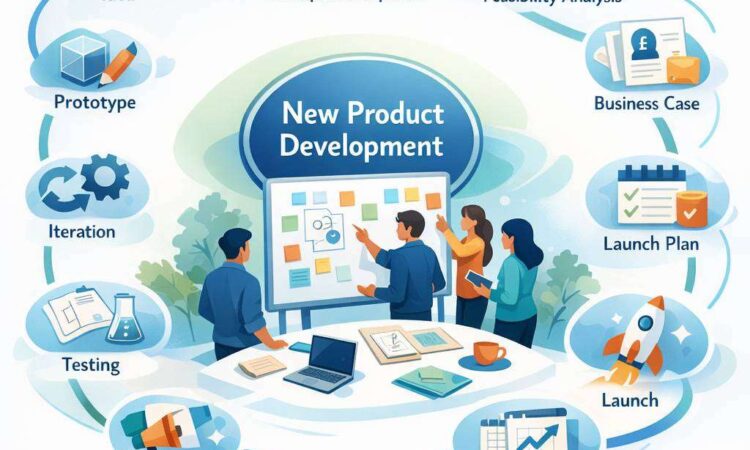
In the fast-paced landscape of modern commerce, organisations rely on disciplined processes to convert ideas into commercially viable products. This article outlines ten proven stages of new product development (NPD) that reputable product development consultancy teams deploy to minimise risk and maximise return on investment. By following these stages, businesses can align strategy, design, validation and execution to deliver products that meet real market needs.
Stage 1: Strategic Alignment and Opportunity Framing
Every successful NPD endeavour begins with clarity about business goals, target customers and the competitive terrain. A rigorous opportunity framing exercise helps identify unmet customer needs, market gaps and potential value propositions. This stage is essential for ensuring that subsequent work—whether conducted by product development companies or product development consultancies—aims at a strategically coherent objective and allocates resources wisely.
New product development drives competitive advantage by aligning customer insights with innovative strategies. Teams collaborate across disciplines to prototype, test, and refine offerings. For expert guidance and resources, explore the following platform: https://forward-npd.com/
Stage 2: Market Research and Voice of the Customer
Insight-driven development is the bedrock of products that resonate. Through qualitative interviews, quantitative surveys and competitive benchmarking, teams capture the Voice of the Customer. Treat this as a continuous input stream rather than a one-off exercise; it informs desirability, pricing hypotheses and feature trade-offs. Product development services and new product development consulting often coordinate these activities to establish a robust market understanding.
Stage 3: Concept Generation and Screening
With a validated need in hand, creative concept generation explores multiple ways to satisfy it. Cross-functional ideation sessions, design thinking workshops and rapid sketching yield a broad concept set. A formal screening process selects concepts with the strongest strategic fit, customer appeal and technical feasibility. This step helps prevent premature commitment to ideas that are unlikely to succeed in the market.
Stage 4: Technical Feasibility and Risk Assessment
Feasibility assessments evaluate whether the proposed concept can be built within the organisation’s capabilities, timelines and budget. Engineers, designers and supply chain specialists map out the technical requirements, potential constraints, prototyping needs and compliance considerations. Early risk assessment identifies critical path activities and highlights areas where a product development consultancy can add value through expert guidance.
Stage 5: Business Case and Economic Modelling
A disciplined business case translates strategic intent into quantified economics. Modelling covers development costs, manufacturing costs, distribution scenarios, pricing, margin optimisation and scenario planning. Sensitivity analyses illuminate the financial resilience of the project under different market conditions. Robust business case work is often a pivotal input for senior sponsorship and decision gates within new product development services.
Stage 6: Concept Optimisation and Prototyping
Concepts are refined, and initial prototypes are produced to test form, function and user experience. Prototyping accelerates learning, enabling iterative validation of technical performance and customer desirability. The most compelling concepts evolve into progressively refined designs, ready for more rigorous testing. A capable product development consultancy will orchestrate cross-functional reviews to ensure alignment across engineering, UX, regulatory, and manufacturing perspectives.
Stage 7: Regulatory Compliance and Quality Assurance
Compliance with regulatory standards and quality assurance requirements is non-negotiable for market success. Early planning for certifications, safety standards and environmental considerations reduces costly redesigns later. Documentation, traceability and supplier qualification are integral to this stage, ensuring that the final product meets both legislative obligations and internal quality benchmarks.
Stage 8: Detailed Design and Engineering Optimisation
Detailed design translates validated concepts into production-ready specifications. Engineers optimise tolerances, materials, assembly processes and cost drivers. Design for manufacturability and assembly (DFMA) principles are applied to streamline production, reduce waste and shorten time-to-market. Collaboration with manufacturers or contract development organisations helps anticipate scale-up challenges and identify potential efficiency gains.
Stage 9: Pilot Production, Validation and Market Testing
A controlled pilot production run validates manufacturing processes and supply chain resilience before full-scale launch. Concurrently, market testing or beta programmes gather real-world feedback on performance, usability and customer satisfaction. This stage mitigates the risk of post-launch issues and provides critical data to refine product features, positioning or go-to-market strategies. Product development services frequently coordinate pilot activities to ensure fidelity between the test and launch environments.
Stage 10: Launch Readiness and Market Introduction
The final stage synchronises all elements for a successful launch. Go-to-market plans, distribution partnerships, pricing strategies and promotional campaigns are executed with precision. Operational readiness, customer support readiness and post-launch monitoring are established to capture early learning and sustain momentum. Whether engaging new product development companies or a product development consultancy, the launch process hinges on cross-functional readiness and disciplined execution.
Throughout these stages, organisations benefit from a structured approach to new product development that combines strategic insight with practical engineering and market validation. Engaging with experienced product development services or a trusted product development consultancy can provide objective governance, access to specialised expertise and scalable processes. For many firms, leveraging external support—whether from budding new product development companies or established specialists in new product development services—enables faster, more reliable paths from idea to successful market entry.
If you are exploring options for your next product venture, consider how your internal capabilities align with the ten stages outlined above. A clear strategic framework, rigorous market validation and disciplined execution are the hallmarks of successful NPD programmes. By integrating these principles with the right partnerships, your organisation can realise meaningful growth through well-managed, market-ready innovations.
FAQ: New Product Development
What is new product development (NPD)?
A structured process of bringing a new product from idea to market, including concept generation, design, testing, manufacturing, and launch.
Why is new product development important for my business?
NPD drives growth, keeps your portfolio competitive, meets evolving customer needs, and can create new revenue streams and market differentiation.
What are the stages of the NPD process?
Common stages include: opportunity identification, ideation, concept development, business case, product design and development, testing and validation, manufacturing planning, market testing, and commercialization.
How do I generate ideas for new products?
Use customer feedback, market research, trend analysis, competitive benchmarking, internal ideation sessions, and co-creation with partners or early adopters.
How do I evaluate ideas and choose which to pursue?
Assess feasibility, desirability, and viability (the triad of NPD). Use criteria like market size, technical feasibility, cost, risk, alignment with strategy, and potential ROI; employ scoring models and stage-gate decisions.
What is a stage-gate (phase-gate) process?
A structured milestone-based approach where projects pass through predefined gates. Each gate requires evidence or deliverables to proceed, pause, or stop the project.
How long does NPD typically take?
Duration varies by industry and complexity—from a few months for incremental improvements to several years for complex hardware or regulated products. A clear timeline and milestones help manage expectations.
How do we manage risk in new product development?
Identify risks early (market, technical, regulatory, supply chain), build validation experiments, run prototypes or pilots, diversify suppliers, and implement robust project governance and contingency planning.
What role do customers play in NPD?
Customers shape concepts, validate features, and test prototypes. Early and ongoing customer involvement reduces risk and improves product-market fit.
How do I measure the success of an NPD project?
Key metrics include time-to-market, development cost, feature validation, user adoption, revenue and margin, customer satisfaction, and post-launch performance.
What tools support new product development?
Idea management software, roadmapping and portfolio management tools, CAD and simulation for design, rapid prototyping equipment, test and validation labs, and project management platforms.
How can I accelerate NPD without sacrificing quality?
Adopt iterative development (agile or lean), use rapid prototyping, parallelise activities where possible, and implement effective cross-functional collaboration with clear decision rights.
What is the difference between incremental and radical innovation?
Incremental innovation improves existing products with minor enhancements; radical (or disruptive) innovation creates new markets or significantly alters the value proposition.
How should we handle regulatory and compliance considerations?
Incorporate regulatory requirements early, engage with experts, maintain thorough documentation, and build in compliance testing and validation throughout development.
What is a minimum viable product (MVP)?
An MVP is the simplest version of a product that can be released to test core value hypotheses, gather user feedback, and learn before full-scale development.
How do we manage intellectual property in NPD?
Identify potentially patentable features, file appropriate IP protections, monitor competitors, and balance openness with protection to preserve competitive advantage.
How can cross-functional teams improve NPD outcomes?
Diverse perspectives (marketing, engineering, manufacturing, QA, supply chain, finance) enhance idea quality, feasibility assessment, risk mitigation, and execution efficiency.
What are common pitfalls in new product development?
Overly optimistic timelines, unclear customer needs, scope creep, insufficient validation, underfunding, poor cross-functional collaboration, and inadequate risk management.
How do we align NPD with overall business strategy?
Ensure projects support strategic goals, allocate resources based on strategic priority, and regularly review portfolio alignment and performance against targets.
Can external partners help with NPD?
Yes, partners such as manufacturers, suppliers, design firms, and contract research organisations can accelerate development, provide specialised expertise, and expand capacity.
What should be included in an NPD roadmap?
A long-term view of planned products, key milestones, resource requirements, risk indicators, and decision gates for prioritisation and funding.
How do I start an NPD initiative in my organization?
Secure leadership sponsorship, define a clear problem or opportunity, assemble a cross-functional team, establish a stage-gate process, and pilot with a small, manageable project.