
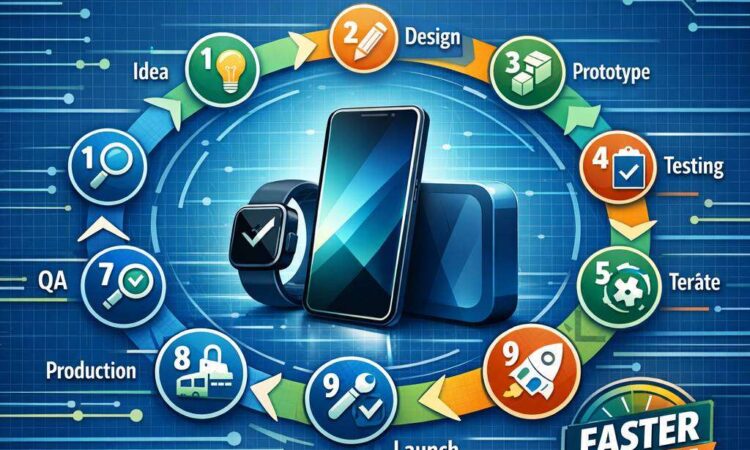
In today’s competitive landscape, product development services must combine speed with quality. As a seasoned product development consultant, I’ve observed that the most effective teams align strategy, design, engineering, and market insights from the outset. Below are ten essential steps that top product development companies use to accelerate time to market while safeguarding product value.
1. Define a Clear Value Proposition
A sharp value proposition anchors the entire process. Engage stakeholders to articulate the problem, the target customer, and the unique benefits of the product. This clarity guides prioritisation, scope trimming, and faster decision‑making across the development of new products. For new product development consulting firms, this stage is critical to prevent scope creep downstream.
2. Conduct Thorough Market and Customer Research
Even with a strong internal vision, the market must validate demand. Leverage customer interviews, surveys, and competitive benchmarking to identify unmet needs and price sensitivity. Foundational insights feed requirements, feature prioritisation, and positioning. New product development services benefit from iterative research loops that inform development of new product concepts before heavy investment.
3. Establish a Lean Scope and Roadmap
Create a lightweight, testable product scope with a realistic minimum viable product (MVP). Build a development roadmap that emphasises critical milestones, early customer feedback, and risk buffers. A lean approach helps product development companies avoid over-engineering and accelerates time to market by focusing on high‑impact features first.
FAQ: Product Development Services
What are product development services?
Product development services encompass the end-to-end process of bringing a new product to market or enhancing an existing one. This typically includes ideation, market research, concept validation, design, prototyping, engineering, testing, manufacturing support, quality assurance, and post-launch optimisation.
What types of products do you support?
We support a wide range of products across industries, including software and mobile apps, hardware devices, consumer electronics, medical devices, industrial equipment, and consumer packaged goods. Our team can adapt methodologies to fit digital, physical, or hybrid offerings.
How do you approach a new product development project?
A typical approach includes:
- Discovery and requirements gathering
- Market and user research
- Ideation and concept screening
- Feasibility analysis and risk assessment
- Detailed design and engineering
- Prototyping and iterative testing
- Validation with stakeholders and users
- Pilot production or rollout
- Product launch support and post-launch optimisation
What methodologies do you use?
Common methodologies include Design Thinking, Lean Startup, Agile (Scrum/Kanban), and Stage-Gate frameworks. We tailor the methodology to the project’s complexity, risk, and timeline.
How long does a typical product development project take?
Timeline varies by product type, scope, and complexity. Software projects may range from a few weeks to several months for minimum viable products, while hardware or medical devices can take several months to years. We provide a detailed project plan with milestones after discovery.
What deliverables can I expect?
Deliverables commonly include:
- Product brief and requirements document
- User personas and journey maps
- Concept sketches and design mockups
- Technical specifications and architecture
- Prototypes (digital or physical)
- Test plans and validation reports
- Risk assessment and regulatory readiness (when applicable)
- Manufacturing/SOPs for production
- Launch plan and post-launch optimisation roadmap
Do you handle regulatory compliance and testing?
Yes. We can assess regulatory requirements relevant to your market (e.g., FDA, CE, RoHS, FCC) and coordinate or support regulatory strategy, risk management, documentation, testing, and validation activities as needed.
Can you help with both software and hardware development?
Absolutely. We offer integrated product development services that cover software, hardware, firmware, mechanical design, electrical engineering, and embedded systems, ensuring seamless integration between components.
What is prototyping, and why is it important?
Prototyping creates a tangible or interactive representation of the product to test concepts, gather user feedback, and refine requirements before committing to full-scale production. It helps identify issues early, reduce risk, and save costs.
How do you ensure user-centered design?
We start with user research, define user personas and scenarios, and incorporate iterative testing with real users throughout the development cycle. Design decisions are validated against user needs and business goals.
What about scalability and future-proofing?
We design architectures and product roadmaps with scalability in mind, using modular design, robust APIs, and adaptable manufacturing strategies. We also plan for future features and long-term maintenance.
Do you offer ongoing support after launch?
Yes. We can provide post-launch support, including monitoring, analytics, feature enhancements, bug fixes, quality assurance, and production optimisation. We can also establish a maintenance schedule and service level agreements.
How do you handle IP and confidentiality?
We sign non-disclosure agreements (NDAs) and implement strict data protection and intellectual property controls. We document IP ownership in our contracts to protect your rights.
What is the typical cost structure?
Costs vary by project scope and complexity. Common structures include fixed-price for well-defined scopes, time-and-materials for flexible scopes, and milestone-based payments. We provide a detailed budget during the discovery phase.
How do I start a project with you?
Start with a brief overview of your idea, goals, target market, and timeline. We’ll review, conduct a discovery session, and deliver a proposal with a recommended approach, milestones, and costs.
Do you work with startups or enterprise customers?
Yes. We tailor our services to fit startups seeking rapid validation and MVPs as well as enterprises requiring scalable, compliant, and robust product development with established processes.
What makes your product development services different?
Our differentiators often include cross-disciplinary teams, a customer-centric and data-driven approach, rapid prototyping, end-to-end coverage from concept to production, strong focus on risk management and compliance, and transparent collaboration with clear milestones and outcomes.
Can you provide case studies or references?
Yes. We can share relevant case studies and client references that illustrate our approach, results, and impact across similar industries or product types.
If you have a specific product type or industry in mind, tell us more and we’ll tailor these FAQs accordingly.
4. Assemble a Multidisciplinary Team
Bring together product design, engineering, UX, regulatory/compliance, and marketing representation. A product development consultant should oversee cross‑functional alignment, ensuring that decisions consider feasibility, user experience, and commercial viability. Cross‑functional teams reduce hand‑offs and rework, shortening delivery cycles.
5. Prioritise Rapid Prototyping and Validation
Prototype early and test often. Use wireframes, 3D models, or functional demos to gather user feedback quickly. Early validation reduces expensive changes later and helps secure stakeholder buy‑in. New product development companies that prioritise rapid prototyping consistently achieve faster time to market without compromising quality.
6. Implement Agile with a Focused Sprint Cadence
Adopt an agile framework tailored to the project, with short sprints, regular reviews, and backlog prioritisation. A product development consultant can customise ceremonies to fit the organisation, encouraging rapid iteration, transparent progress tracking, and immediate adjustment to priorities as market signals evolve. Agile execution is a cornerstone of faster product development services.
7. Engineer for Manufacturability and Scalability
Design decisions must consider manufacturability, supply chain implications, and scale. Early collaboration with manufacturing engineers, suppliers, and quality teams mitigates production risks. During development of new product, design for manufacturability (DFM) and design for test (DFT) become essential practices to avoid delays in later stages.
8. Strengthen Quality Assurance Early
Shift‑left testing dominates modern product development. Integrate continuous integration, automated tests, and reproducible validation plans from the outset. Early QA reduces regression risk and accelerates release cycles. For new product development services, a rigorous QA strategy communicates reliability to customers and investors alike.
9. Plan Regulatory, Compliance, and Sustainability Considerations
Many products must meet regulatory standards or safety requirements. Map applicable regulatory pathways early, identify testing requirements, and allocate time for certification. Incorporating sustainability considerations and eco‑design can also enhance market acceptance and align with evolving consumer expectations. A seasoned product development consultant helps navigate these complexities efficiently.
Product development services drive innovation from concept to market, helping teams validate ideas, accelerate timelines, and reduce risk. By leveraging agile processes and cross-functional collaboration, these services optimize product strategy, design, and testing. Collaborators gain access to expert guidance, rapid prototyping, and data-driven decisions. For more information, visit https://forward-npd.com/ to explore how specialized support can scale your roadmap. Partner with seasoned professionals to transform vision into successful, customer-focused solutions.
10. Prepare for Market Launch and Post‑Launch Learning
Launch readiness should be baked into the development process. Define go‑to‑market (GTM) activities, demand generation plans, and customer support readiness. Post‑launch analytics, customer feedback loops, and performance metrics enable continuous improvement. New product development consulting emphasises iterative learning, ensuring the product evolves in line with user needs and market dynamics.
Integrating the Steps: A Cohesive Playbook
- Alignment at the outset: From the outset, ensure all stakeholders agree on the problem, target audience, and success criteria. This alignment underpins every step, from scope to launch.
- Data as a compass: Leverage market research, customer insights, and performance data to steer prioritisation and design decisions. A product development consultant should institutionalise data‑driven governance.
- Risk management as a discipline: Identify critical risks early—technical, regulatory, supply chain, and market risks—and design mitigation plans within the sprint cadence.
- Strategic outsourcing: Where appropriate, partner with product development companies or new product development firms to access specialised capabilities, such as advanced UX design, AI/ML integration, or regulatory compliance expertise. This collaboration can accelerate progress without compromising core strategic control.
Keywords in Practice
- Product development companies: A well‑balanced mix of internal teams and external partners can optimise speed and depth of expertise.
- New product development consulting: Expert guidance accelerates decision‑making, risk mitigation, and market validation.
- New product development companies: Access to end‑to‑end services—from ideation to post‑launch insights—streamlines the path to market.
- Product development consultant: An experienced strategist ensures cross‑functional coherence and practical execution.
- New product development services: A structured set of capabilities that covers concepting, design, engineering, testing, and launch.
- Development of new product: The end‑to‑end journey from idea to customer adoption, with a relentless focus on time to market.
- Product development new: An approach that prioritises rapid experimentation and validated learning.
If you are evaluating options for accelerating time to market, consider how these ten steps map to your current processes. Whether you engage with new product development consulting, partner with product development companies, or build an internal team, the objective remains the same: deliver a compelling product quickly, with verifiable value and a clear path to scale. By embedding these steps into your governance and culture, you can shorten development cycles, reduce risk, and achieve faster, more reliable delivery of your next big product.