
Regular walkers know something the rest of the population keeps rediscovering every January: the habit matters more than the distance. A daily mile kept up for years beats an occasional heroic hike every time. Which is why the saddest thing that happens to lifelong walkers isn’t slowing down. Slowing down is fine; the hills allow for it. It’s stopping.
People stop for reasons that look small from the outside. A stumble that knocked their confidence more than their hip. A knee that makes the first ten minutes miserable, so the walk keeps getting postponed until the weather improves, and somehow never does. A partner who used to come along and now can’t be left alone in the house. The boots stay by the door, and six months later the leg strength and balance that made walking feel effortless have quietly gone, which makes starting again feel risky, which keeps the boots by the door. It’s a loop, and it tightens.
Why the loop is worth breaking
The health case is not subtle. NHS guidance on activity in later life, at nhs.uk/live-well/exercise, is blunt that some activity is vastly better than none, and that strength and balance work is what reduces falls, the single event most likely to end independent living. Walking, especially with a bit of gradient in it, covers most of what’s asked: legs, lungs, balance, daylight, and the mood benefits that walkers never need explaining.

There’s a social layer too, which festival-goers understand in their bones. A walk is a conversation with scenery. People who walk together stay connected; people who stop walking often start disappearing from the diary altogether. Keeping someone walking is rarely just about their knees.
A walking partner in disguise
This is an underrated part of what home care actually does. Yes, a home caregiver helps with the practical things: medication, meals, getting washed and dressed in the morning. But ask families what changed their parent’s life and a surprising number say the same thing: someone to walk with.
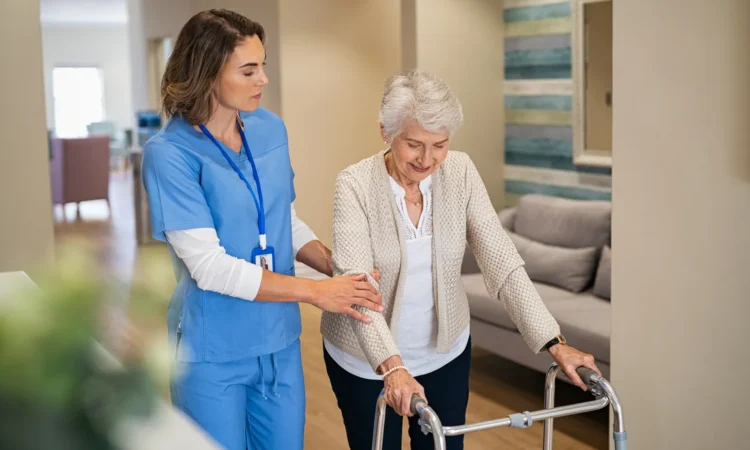
An arm to steady the first ten minutes until confidence catches up. Company that turns a daunting loop of the block back into a pleasant one. Someone who knows the difference between encouraging and hurrying. And, just as often, someone at home with a spouse so that the walker can actually leave the house without listening for the phone the whole way round. A regular visit, timed for the right part of the day, quietly rebuilds the habit that a single stumble dismantled.

Starting again, gently
For anyone helping a parent or neighbour back onto their feet, the pattern that works is small, regular and companioned. The same short loop, most days, at the same time, with someone alongside. Benches noted and used without apology. Poles or a stick if they help; pride is a poor reason to fall. Distance is allowed to grow at its own pace, because the goal isn’t the distance. It’s the dailiness.
So if there’s someone in your life who used to be a fixture on the local footpaths and has drifted indoors, the fix might not be encouragement. Encouragement they’ve had, probably by the bucketload. It might be an hour of the right support at the right time of day. The paths are still there. Most people, given a steady arm and a reason, are very glad to be back on them.