
An artificial grass tennis court offers consistent bounce, low maintenance, and year-round playability for clubs and homes alike. Players enjoy smooth movement, quicker setup, and a durable surface that resists weather impacts. With modern turf, vibration is reduced, reducing strain on joints during long matches. To explore installation options and expert care, visit the following resource in the second half: https://www.artificialgrassmaintenance.co.uk. Consider your space, budget, and climate to choose the right turf system.
Artificial grass tennis court surfaces offer consistent ball bounce, low maintenance, and excellent playability for year-round practice. Ideal for clubs seeking durable, weather-resistant courts with reduced upkeep, these synthetic fields emulate real turf while minimizing water usage and mowing costs. Players appreciate uniform resistance and shock absorption during rallies. For more on maintenance options, consider the following resource: https://armorcourts.com/court-maintenance/.
A modern artificial grass tennis court offers consistent bounce, low maintenance, and year-round playability for enthusiasts and clubs. It combines durability with a natural look, reducing dust and mud on shots and footwork. https://pressurewashingresource.com/community/t/tennis-court-tomorrow/24868
Artificial grass tennis courts are a popular choice for clubs and private facilities due to their consistency, lower maintenance demands, and year-round playability. Selecting the right filler is crucial to maximise longevity, maintain playing characteristics, and minimise ongoing tennis court maintenance costs. This article, written from an expert perspective, lays out the best filler options for artificial grass tennis court systems and explains how each affects performance, durability, and upkeep.
An artificial grass tennis court offers consistent playability and low maintenance for busy facilities. Its cushioned surface reduces fatigue while providing dependable ball bounce, ideal for clubs and schools alike. Durable fibers resist infill displacement, maintaining a smooth, uniform feel over time. For more information on upkeep and expert guidance, visit: https://www.californiasportssurfaces.com/tennis-court-maintenance-new-owners/.
The role of fillers in artificial grass tennis courts
In an artificial grass tennis court, fillers are used to stabilise the turf fibres, provide weight for a realistic playing feel, and enhance ball bounce characteristics. Fillers also help to suppress dust and regulate surface hardness. The choice of filler impacts rainfall drainage, weed suppression, and the frequency of tennis court cleaning and resurfacing tasks. When considering tennis court installation, builders often tailor filler blends to local climate, usage levels, and the specific pile height of the synthetic grass.
Common filler options and longevity considerations
-
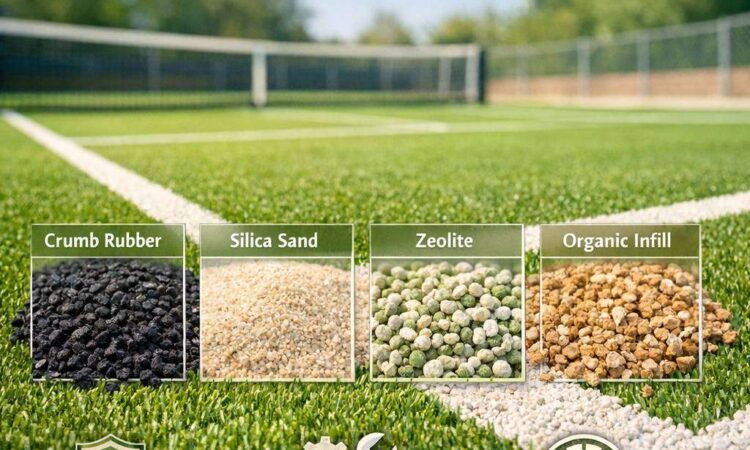
Quartz or silica sand: This is the traditional, cost-effective filler. It provides good ballast, natural ball bounce, and helps hold fibres upright. Longevity is generally strong in moderate climates, but sand can compact over time, reducing porosity and increasing surface hardness if regularly over-tamped during tennis court maintenance. For resurfacing intervals, sand-filled systems often require periodic top-ups to maintain ideal fibre stability and bounce.
-
Crumb rubber: A recycled tyre-based option that improves resilience and energy return. It can enhance shock absorption, reducing stress on joints for players during long sessions. However, crumb rubber may raise environmental and odour concerns in some facilities and can complicate cleaning regimes. In high-usage facilities, crumb rubber can migrate within the tufting system, potentially affecting playability if not properly installed or maintained. Longevity is good when integrated with appropriate drainage and infill depth.
-
EVA or EPDM infill pellets: These polymer foams offer uniform bounce and excellent resistance to compaction. They’re often used in performance-focused installations where consistent playability matters for tennis training programmes. EVA/EPDM infill tends to maintain deformability over longer periods, resulting in fewer annual maintenance interventions but higher initial installation costs. Longevity tends to exceed that of traditional sands in demanding climates.
-
Zeolite or cushioned infills: Zeolite blends provide silica-like density with enhanced drainage and moisture management. They can reduce surface hardness and mitigate heat absorption. Longevity is competitive with silica sand for many climates, and these blends can lower the frequency of tennis court cleaning by reducing dust.
-
Hybrid infill systems: Some operators combine silica sand with a secondary polymer or natural fibre to balance hardness, bounce, and dust control. These hybrids aim to maximise longevity by distributing load and improving fibre retention, reducing the need for frequent tennis court maintenance visits.
Quartz or silica sand: This is the traditional, cost-effective filler. It provides good ballast, natural ball bounce, and helps hold fibres upright. Longevity is generally strong in moderate climates, but sand can compact over time, reducing porosity and increasing surface hardness if regularly over-tamped during tennis court maintenance. For resurfacing intervals, sand-filled systems often require periodic top-ups to maintain ideal fibre stability and bounce.
Crumb rubber: A recycled tyre-based option that improves resilience and energy return. It can enhance shock absorption, reducing stress on joints for players during long sessions. However, crumb rubber may raise environmental and odour concerns in some facilities and can complicate cleaning regimes. In high-usage facilities, crumb rubber can migrate within the tufting system, potentially affecting playability if not properly installed or maintained. Longevity is good when integrated with appropriate drainage and infill depth.
EVA or EPDM infill pellets: These polymer foams offer uniform bounce and excellent resistance to compaction. They’re often used in performance-focused installations where consistent playability matters for tennis training programmes. EVA/EPDM infill tends to maintain deformability over longer periods, resulting in fewer annual maintenance interventions but higher initial installation costs. Longevity tends to exceed that of traditional sands in demanding climates.
Zeolite or cushioned infills: Zeolite blends provide silica-like density with enhanced drainage and moisture management. They can reduce surface hardness and mitigate heat absorption. Longevity is competitive with silica sand for many climates, and these blends can lower the frequency of tennis court cleaning by reducing dust.
Hybrid infill systems: Some operators combine silica sand with a secondary polymer or natural fibre to balance hardness, bounce, and dust control. These hybrids aim to maximise longevity by distributing load and improving fibre retention, reducing the need for frequent tennis court maintenance visits.
When evaluating long-term performance, consider how each filler interacts with your grass pile height, fibre type, drainage system, and the anticipated play load. A well-designed system can tolerate regular play and weather fluctuations with minimal re-infestation of weeds or surface degradation.
Practical guidelines for selection and upkeep
-
Assess climate and usage: For high rainfall regions, prioritise fillers that maintain porosity and prevent surface hardening. In busy urban facilities with heavy play, choose fillers that resist compaction and maintain consistent bounce.
-
Consider maintenance workflows: Some fillers require less frequent topping up and cleaning. For instance, polymer-based infill systems can reduce dusting and simplify tennis court cleaning, while sand-only systems may demand more regular replenishment to compensate for washout or compaction.
-
Inspection and monitoring: Regular checks during tennis court maintenance should assess fibre stand-up, pile tilt, and infill depth. Installers should verify that the system’s porosity remains within design specifications to sustain stable ball bounce and prevent uneven wear.
-
Cleaning and resurfacing cycle: The addition of certain fillers can influence how often you should perform tennis court cleaning and, eventually, tennis court resurfacing. Less dust and better drainage improve overall surface reliability, potentially extending between resurfacing cycles.
-
Spares and topping up: Build a plan for topping up or replenishing infill before it becomes a problem. A small, consistent topping routine is easier and more cost-effective than tackling major re-infestation of weeds or uneven fibres later.
-
Compatibility with maintenance equipment: Ensure that your chosen filler is compatible with your cleaning equipment and brushing methods. Some fillers can be spread more evenly by mechanised systems, supporting uniform wear and reducing hotspots.
Assess climate and usage: For high rainfall regions, prioritise fillers that maintain porosity and prevent surface hardening. In busy urban facilities with heavy play, choose fillers that resist compaction and maintain consistent bounce.
Consider maintenance workflows: Some fillers require less frequent topping up and cleaning. For instance, polymer-based infill systems can reduce dusting and simplify tennis court cleaning, while sand-only systems may demand more regular replenishment to compensate for washout or compaction.
Inspection and monitoring: Regular checks during tennis court maintenance should assess fibre stand-up, pile tilt, and infill depth. Installers should verify that the system’s porosity remains within design specifications to sustain stable ball bounce and prevent uneven wear.
Cleaning and resurfacing cycle: The addition of certain fillers can influence how often you should perform tennis court cleaning and, eventually, tennis court resurfacing. Less dust and better drainage improve overall surface reliability, potentially extending between resurfacing cycles.
Spares and topping up: Build a plan for topping up or replenishing infill before it becomes a problem. A small, consistent topping routine is easier and more cost-effective than tackling major re-infestation of weeds or uneven fibres later.
Compatibility with maintenance equipment: Ensure that your chosen filler is compatible with your cleaning equipment and brushing methods. Some fillers can be spread more evenly by mechanised systems, supporting uniform wear and reducing hotspots.
Final thoughts on longevity and performance
Choosing the best artificial grass tennis court filler is not simply a cost decision; it’s a strategic choice that influences play characteristics, surface safety, and the frequency of tennis court maintenance. Hybrid and polymer-based infills tend to offer the most durable, consistent performance for demanding tennis clubs and school facilities, particularly when paired with appropriate drainage and grass system design. Conservative sand-only designs remain viable for many community courts but may require more meticulous upkeep to prevent compaction and softness loss over time.
When planning tennis court installation or refurbishment, consult with a specialist who understands artificial grass tennis systems, including the nuances of tennis court cleaning, resurfacing cycles, and long-term maintenance strategies. A well-chosen filler, combined with disciplined maintenance practices, can deliver a high-performance, resilient surface that remains playable and cost-effective for years.